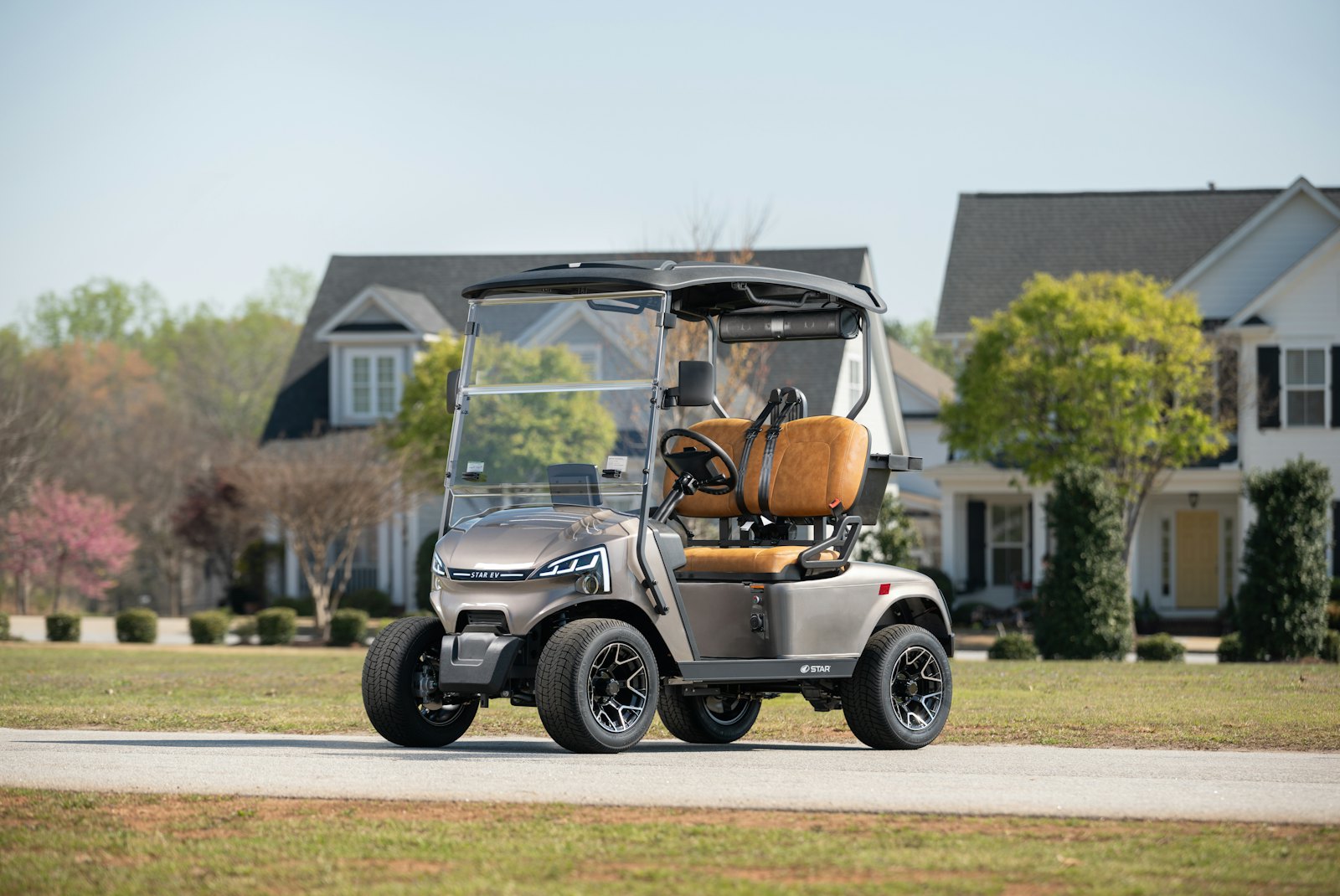
Short answer: buy Evolution golf cart parts by the exact model, year, and component number whenever possible. “Fits Evolution” is too broad because D5, Classic, Forester, Carrier, and Turfman carts can use different body parts, electrical connectors, windshields, and mounting points.
This guide is a practical map for finding replacement and upgrade parts without assuming the whole Evolution range is interchangeable. If you own a D5, also see our D5 Maverick guide and D5 Ranger guide.
Start with model identification
Before ordering, record the model name, approximate model year, battery-system voltage, and any part number printed on the original component. For lighting, body panels, windshields, switches, chargers, and suspension pieces, photos of the connector and mounting points can prevent expensive mistakes.
Common Evolution part categories
- Body and weather: windshields, roof hardware, trim, mirrors, enclosures, and body fasteners.
- Electrical: ignition switches, lighting components, 12V power harnesses, chargers, and charging cords.
- Wheels and hubs: center caps, wheels, tires, bearings, and hub-related hardware.
- Interior: seats, storage pieces, dash accessories, phone holders, and audio mounts.
- D5-specific accessories: power adapters, lighting components, enclosures, and model-specific storage.
Current Evolution parts worth comparing
Affiliate disclosure: We may earn a commission from qualifying purchases. Verify exact model and year fitment before ordering.
Replacement windshield for Classic/Forester
This is a good example of why model naming matters: it targets Classic/Forester carts rather than every Evolution model.

Ignition switch assembly for multiple Evolution/HDK models
For switches, compare the connector, key-switch body, and listed model family with the original part before buying.

Evolution center dust cover / hub cap
This accessory lists several Evolution families including D5. Wheel diameter and the exact center-cap interface still matter.

OEM number vs visual matching
Visual matching is useful, but a printed OEM or replacement part number is stronger evidence. Two switches or trim pieces can look almost identical while using different plugs or mounting clips. When a listing provides a cross-reference number, compare it with the original component.
Electrical parts need an extra check
Voltage alone does not guarantee compatibility. Confirm connector type, polarity, current rating, and whether the part expects a 12V accessory circuit or the full traction-pack voltage. This is especially important on D5 carts when adding lighting or accessories.
When to use a dealer or service manual
If the part affects braking, steering, high-current battery wiring, suspension geometry, or a safety system, use official documentation or a qualified technician. Generic marketplace fitment is not enough for safety-critical work.
How to avoid ordering the wrong Evolution part
- Record the full model name and year.
- Photograph the existing component and connector.
- Check dimensions and mounting-hole spacing.
- Confirm electrical voltage/current where applicable.
- Read the listing exclusions, not only the headline compatibility.
Write down any molded or printed part numbers.
Parts that deserve extra verification
Chargers, brake components, steering parts, controllers, suspension pieces, and high-current electrical parts deserve more verification than cosmetic accessories. Confirm the official part number where possible and avoid treating a visually similar connector as proof of compatibility. A wrong cosmetic part is inconvenient; a wrong steering, braking, or high-current electrical part can create a safety or reliability problem.
Used and salvaged Evolution parts
Used parts can make sense for body trim, brackets, and hard-to-find OEM pieces, but inspect cracks, corrosion, threads, electrical pins, and mounting tabs. For wear items such as bearings, switches, bushings, and contactors, a new part with clear fitment is usually easier to evaluate than an unknown used component.
Keep a simple parts record
When you replace a component, save the old part number, the new part number, purchase date, and a photo of the connector or mounting location. That record makes future repairs much faster and helps distinguish an original Evolution component from an aftermarket replacement. It is especially useful on carts that receive multiple upgrades over time.
Bottom line
Evolution parts are easiest to buy when you treat the model family as the starting point, not the finish. Match the exact cart, part number, connector, dimensions, and mounting points. That approach is slower than buying a generic “Evolution” part, but it sharply reduces returns and compatibility problems.