
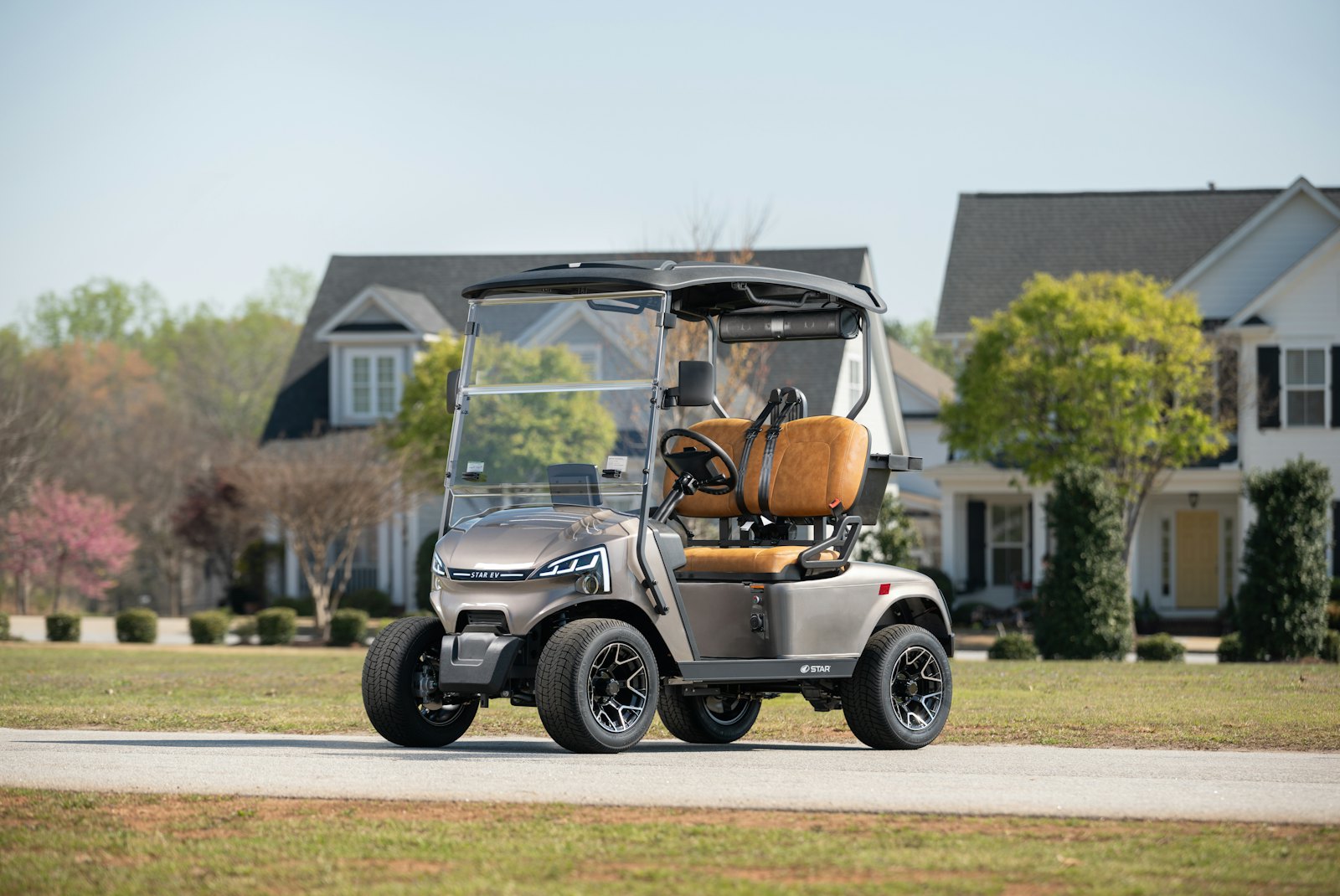
Club Car DS dimensions and weight vary by model year, powertrain, roof, tires, and accessories, so there is no single number that describes every DS built from 1980 through 2014. For transport, covers, lifts, or suspension work, measure the actual cart and use the owner’s manual for its exact serial range.
Typical Club Car DS size
A standard two-passenger DS is commonly around 91–92 inches long, roughly 47 inches wide, and about 68–69 inches high with a standard roof. Those figures are useful for planning garage space, but they are not a substitute for measuring a lifted cart, rear-seat conversion, larger tires, mirrors, or an aftermarket roof.
Wheelbase and stance
The DS uses a compact golf-car wheelbase and narrow track designed for course use. That compact footprint is one reason DS carts remain popular for neighborhoods, utility conversions, and transport. However, wheel offset, spacers, wider tires, and lift kits can increase the effective width beyond the stock body.
Weight varies most by powertrain
Gas and electric DS carts can differ substantially in curb weight. Electric models carry multiple deep-cycle batteries, while gas versions carry an engine, fuel system, starter/generator, and fuel. Battery chemistry also matters: a traditional flooded-lead-acid pack can add significantly more weight than a modern lithium conversion.
Club Car’s current FAQ notes that overall vehicle weight depends on powertrain, seating, and model type. That principle is especially important with a platform as old and frequently modified as the DS.
Do not use curb weight as payload capacity
Curb weight is the vehicle’s own weight, not the amount it can safely carry. Passenger capacity, rear-seat conversions, cargo racks, batteries, and accessories all add load. If a DS has been converted to four-passenger use, the suspension, tires, rear seat frame, grab bar, and footplate should all be evaluated as part of the passenger conversion.
Stock tire and wheel considerations
Many DS carts use 8-inch golf-cart wheels with common stock-style tire sizes, but tire diameter and wheel offset should still be verified. Larger tire packages may require a lift and can change steering effort, ground clearance, scrub radius, and total height.
Our Club Car DS wheel and tire guide explains the fitment checks in more detail.
Ground clearance changes quickly with upgrades
Stock DS ground clearance is modest because the vehicle was designed for turf and paved cart paths. Larger tires and lift kits can increase clearance, but they can also change steering geometry and center of gravity. If the cart is already lifted, do not use stock height or transport-clearance numbers.
Gas DS specifications
Gas DS specifications depend on year. Club Car’s history identifies the FE290 overhead-valve engine as an important 1992 introduction, while earlier and later gas configurations can differ. When ordering fuel, ignition, exhaust, starter/generator, or drive components, match the exact model year and engine rather than using a generic “DS gas” label.
Electric DS specifications
Electric DS carts also span multiple electrical generations. Pack voltage, motor/control system, charger receptacle, and charger logic can vary. Record the battery configuration and charging connector before replacing electrical components.
See our DS models and years guide for the main generation differences.
Measure before buying a cover or trailer
Measure overall length from the farthest front point to the farthest rear accessory, width at the widest fixed component, and height from the ground to the highest roof or accessory. Include mirrors, rear seats, grab bars, roof racks, windshields, and lifted suspension. For trailers, also confirm total weight and tie-down points.
Bottom line
A stock two-passenger Club Car DS is a compact cart roughly in the low-90-inch length and high-40-inch width range, but real-world DS carts vary heavily after decades of modifications. Use generic dimensions only for rough planning; use the exact serial-range manual and physical measurements for parts, transport, covers, and service.
n
Rear-seat conversions change the practical dimensions
A flip rear seat can add meaningful length behind the stock body, while grab bars and footplates can become the farthest rear points. Measure with the seat in the position used for storage or transport. The same rule applies to mirrors and windshields: measure the widest and tallest installed configuration, not only the factory body shell.


