
For most first-time golfers, a complete golf club set is the simpler buy. You get a workable mix of clubs in one purchase, usually with a bag, and you can spend more time learning to hit shots than comparing individual shafts and lofts. Buying clubs separately makes more sense if you already own a few good clubs, need a special fit, or know exactly which gap you want to fill.
The important question is not whether a boxed set has the maximum number of clubs. It is whether the clubs fit you, cover different shots, and leave room in your budget for practice. Here is how to decide without paying for equipment you may not use.
TL;DR: Complete set or individual clubs?
- Starting from zero? A complete beginner set is usually the easiest and more economical route.
- Already own usable clubs? Replace missing or poorly fitting clubs individually instead of buying everything again.
- Need unusual length, grip size, or shaft specifications? Try clubs in person and consider fitting or a custom selection.
- Eight to ten useful clubs can be enough. The Rules of Golf allow up to 14, but do not require 14.
- Compare what is actually in the box. A putter, wedge, long-shot option, and bag matter more than a large “piece count.”
- Upgrade gradually. Add a club when your shots reveal a real distance or short-game gap.
For a starting point, compare the clubs in a beginner golf club set with what you would need to buy separately. Check handedness and shaft length before looking at any product listing.
Shop a beginner set to compare
As an Amazon Associate, GolfCartBase earns from qualifying purchases. This is an example of a complete set, not a claim that one model fits every golfer. Check the exact contents, size, and handedness before buying.
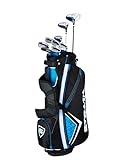
- The Strata 12-Piece Men's is designed to give you maximum performance right out of the box for more confidence from tee-to-green. The lightweight 460cc forged driver, fairway wood, hybrid, irons and putter make up a set that provides a great combination of distance, forgiveness and control, and is very easy to hit.

Complete golf club set vs individual clubs: key differences
| Decision factor | Complete set | Individual clubs |
|---|---|---|
| Upfront shopping | One purchase, often with bag | Several choices and purchases |
| Cost for a whole bag | Usually lower than buying comparable new clubs separately | Often higher, but you can buy fewer clubs |
| Fit options | Limited size and shaft choices | More control over length, flex, grips, and heads |
| Club spacing | Designed as a collection, but check the actual lofts | You must check for overlapping distances |
| Best for | New players without equipment | Golfers filling gaps or needing specific fit |
| Upgrade path | Swap individual clubs later | Build the bag gradually from the start |
What a complete set actually includes
There is no single standard definition of a “complete” set. A typical starter package may have a driver, a fairway wood or hybrid, several irons, a pitching wedge, a putter, and a golf bag. Some include a sand wedge or headcovers; others do not. The number on the package may count the bag and headcovers as pieces, so read the club list rather than assuming “12-piece” means 12 clubs.
Callaway’s complete-set buying guide notes that beginner packages commonly include fewer than 14 clubs and should be judged by fit and composition. A starter does not need a separate club for every imaginable shot.
A practical first-bag checklist
- Tee shot: A forgiving driver or fairway wood that you can launch consistently.
- Long approach: A hybrid or fairway wood that feels manageable from the turf.
- Approach shots: Several cavity-back irons covering different distances.
- Short game: At least a pitching wedge; consider a sand wedge if bunkers are common.
- Putting: A putter you can aim comfortably.
- Carrying: A bag that works with how you play, whether walking, using a push cart, or riding.
Not sure why a hybrid and iron behave differently? Our guide to the types of golf clubs explains what each club is designed to do.
When a complete set is the smarter purchase
You are new and do not know your distances
At the start, you may hit a 6-iron and 7-iron nearly the same distance. Spending extra to create perfect loft gaps on paper will not fix inconsistent contact. A basic set lets you discover which shots you actually use. After a few rounds and range sessions, your needs become clearer.
You want predictable total costs
When comparing prices, include the bag, putter, wedges, and headcovers if needed. A seemingly inexpensive set of irons is not a complete playable bag. A package can simplify that math. Still, compare the actual included clubs rather than assuming every box set is a bargain.
You would rather spend on lessons and rounds
A new golfer benefits from time hitting balls and learning basic course management. If buying individual premium clubs leaves nothing for practice, the equipment budget may be working against you.
When buying individual golf clubs makes more sense
You already have a playable bag
Suppose you inherited irons, a putter, and a bag that fit reasonably well. You may only need a hybrid and a wedge to start. Buying another complete set could duplicate equipment you already own. Inspect used clubs for cracked heads, damaged shafts, loose grips, and unusual lengths before keeping them.
Standard package sizing does not suit you
If standard clubs force an awkward posture, try different lengths and lie angles at a golf shop or with a qualified fitter. The right size depends on more than height alone, including wrist-to-floor measurement and how you deliver the club. Do not assume a “tall” or “petite” label guarantees a good fit.
You have identified a specific problem
Perhaps you struggle to launch a long iron but hit your short irons well. Trying a hybrid is more targeted than replacing the entire bag. Or you may need a sand wedge for a course with deep bunkers. Buy to solve a known problem, not because a new model has arrived.
What does each approach really cost?
There is no honest universal dollar comparison. A new premium package can cost more than a carefully assembled used bag. A brand-new driver, iron set, wedges, putter, and bag bought separately can cost substantially more than a basic starter package. The result depends on condition, brand, fitting, and what you already own.
Use this simple method: write down the exact clubs and bag you need. Compare a package that includes those items against the combined cost of equivalent separate purchases. Leave out extras you will not use, and include any missing wedge or bag you would have to buy later.
Check fit before deciding
Even an affordable set is poor value if it is uncomfortable to swing. Check right- or left-handed orientation, club length, shaft weight and flex, grip size, and whether the bag suits your usual way of playing. A stand bag or cart bag can change the real usefulness of a package. If you walk with a push cart, make sure the included bag stays secure and allows access to its pockets.
Also inspect distance gaps once you can strike the ball reasonably consistently. Two clubs with similar printed lofts do not always travel the same distance, and different lofts do not guarantee useful separation. Record your own carry distances at the range rather than trusting a chart intended for someone else’s swing.
Can you start with fewer than 14 clubs?
Yes. Under USGA Rule 4.1b, the maximum is 14 clubs, not a required number. A beginner can comfortably start with a smaller selection and add clubs over time.
For example, a practical nine-club setup might be a driver, hybrid, 6-iron through 9-iron, pitching wedge, sand wedge, and putter. Someone who finds the driver difficult might use a fairway wood instead. The right combination is the one that covers shots you can actually play.
A sensible upgrade plan
- Start with fit. Choose a package or used selection that lets you address the ball comfortably.
- Play and practice. Learn which clubs you reach for and which you avoid.
- Measure gaps. Record approximate carry distances when contact becomes more repeatable.
- Replace one weak link. Test a hybrid, wedge, or putter before making a large purchase.
- Keep the good clubs. You can mix a starter-set iron with a newer hybrid or putter. The bag does not have to match.
Keeping your clubs easy to find also helps during rounds. See our golf bag organization guide for a simple layout.
Frequently asked questions
Is a complete golf set good enough for regular play?
Yes, provided the clubs fit and are in good condition. Many beginner packages are designed for regular recreational golf. Replace individual clubs only when there is a clear reason.
Should a beginner buy new or used clubs?
Either can work. New starter sets are simpler to compare and usually have clearer return policies. Used clubs can offer good value if you can inspect their condition and specifications.
Do all complete sets include a sand wedge?
No. Contents vary by model and configuration. Check the manufacturer’s club list rather than the advertised piece count.
Can I add individual clubs to a complete set?
Yes. You can replace or add clubs as long as your bag complies with the 14-club limit during a round.
The decision
If you have no equipment, choose a complete set that fits and covers the basic shots. If you already have clubs, or need specific dimensions, build around what works and buy only what is missing. In either case, let your actual shots guide the next purchase.