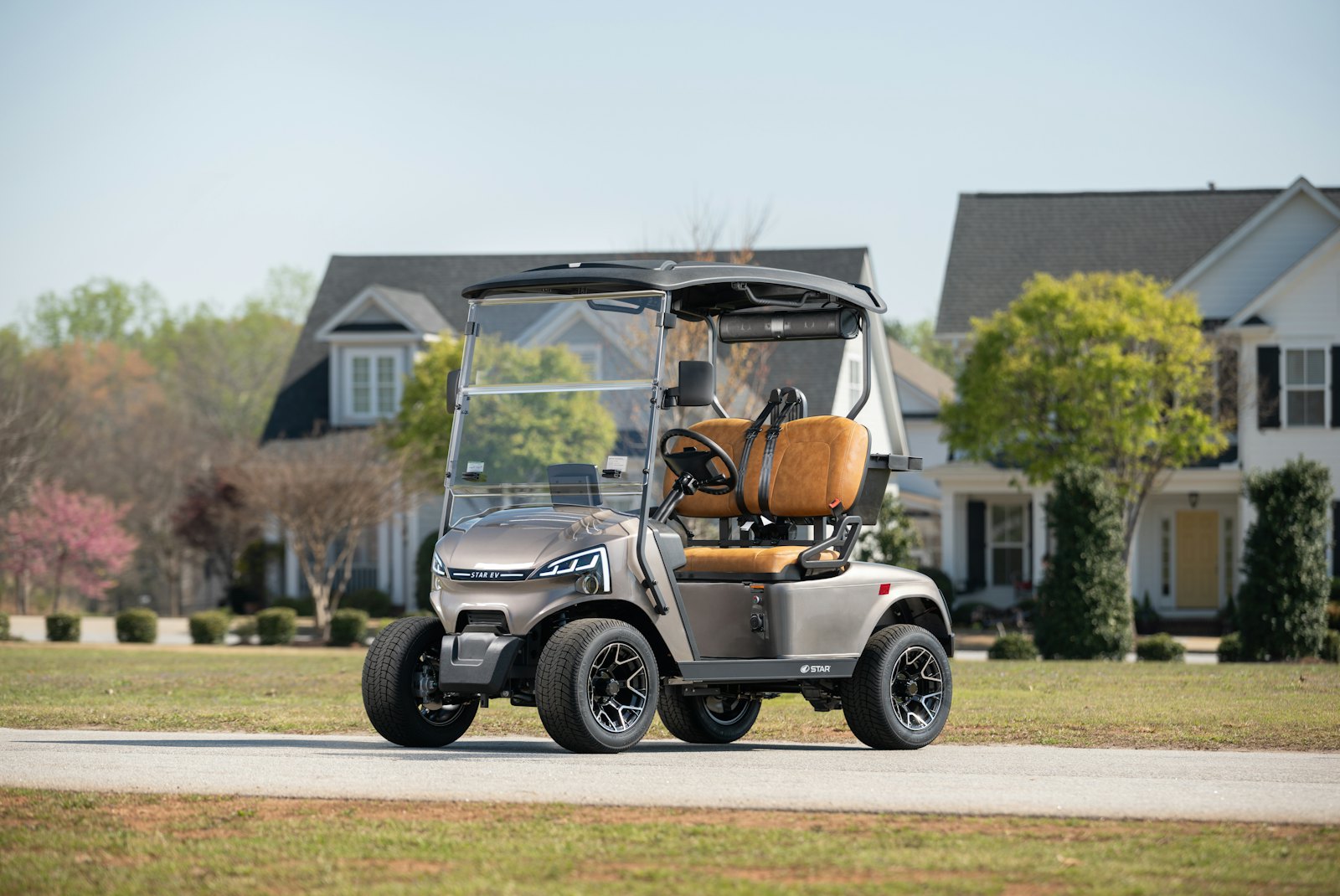
Electric golf carts support far more accessories than lights and a phone charger, but every electrical add-on has to respect the cart’s traction voltage, accessory-voltage architecture, fuse protection, and available current. The most useful electric golf cart accessories improve visibility, comfort, storage, charging, or daily convenience without creating battery imbalance or messy wiring.
Start with the 12V power system
Many accessories are designed for 12V even when the cart uses a 36V or 48V battery pack. A properly sized DC-DC reducer is the foundation for USB outlets, horns, lights, fans, and audio equipment. Do not power accessories by tapping one battery in a multi-battery pack.
Affiliate disclosure: We may earn a commission from qualifying purchases.
Best foundational accessory: voltage reducer

Best for: creating a stable 12V supply from a higher-voltage electric cart when the existing accessory circuit is inadequate or absent.
Best wiring upgrade: fused distribution block

Best for: keeping several accessory circuits organized and individually protected instead of stacking multiple wires on one power terminal.
Best lighting-style upgrade with integrated reducer

Best for: owners who want decorative lighting while reducing the need for a separate 12V lighting feed, provided the product’s input-voltage range matches the cart.
USB charging
USB-C and USB-A ports are among the most practical upgrades for phones, GPS devices, portable speakers, and fans. Choose a weather-resistant panel or socket, mount it where water cannot pool, and feed it from a regulated, fused 12V circuit.
Fans for hot-weather use
Rechargeable fans avoid permanent wiring, while hardwired fans are cleaner for frequent use. If you already have a healthy 12V accessory bus, a fixed fan can make sense. If not, a rechargeable clip or magnetic fan is simpler. See our electric golf cart fan guide.
Lighting and visibility
Headlights, taillights, brake lights, turn signals, and mirrors can make nighttime or neighborhood operation safer. Model-specific light kits may require body cutouts, factory-style connectors, or brake-switch integration. A 12V label alone does not prove fitment.
Audio systems
Portable speakers need almost no vehicle wiring. Soundbars and amplifiers can draw significantly more current and should have appropriately sized wiring, fusing, and reducer capacity. Plan audio load before choosing a reducer rather than adding a larger sound system to an undersized circuit later.
Battery monitors
A battery meter can be useful, but it must support the actual pack voltage and chemistry. A generic voltage display is not the same as a true state-of-charge system. Lithium packs may rely on a BMS display or app, while lead-acid voltage varies with load and rest time.
Electric accessories that do not need cart power
Rechargeable fans, portable speakers, magnetic lights, and battery-powered dome lights can reduce wiring complexity. They are especially useful on carts where you do not want to modify the factory harness.
Key-switched vs always-on circuits
Some accessories should shut off with the ignition to avoid parasitic drain. Others, such as certain charging ports or trackers, may need constant power. Use relays or a switched fuse block when appropriate instead of leaving every accessory permanently live.
Weatherproof the connections
Outdoor exposure is hard on electrical connections. Use heat-shrink terminals or sealed connectors, secure cables away from steering and suspension movement, and add grommets where wires pass through panels. A waterproof accessory can still fail if its connector corrodes.
Bottom line
The best electric golf cart accessories are built around a safe accessory-power foundation. Start with a correct reducer and fuse strategy, then add charging, lighting, fans, audio, and convenience features within the system’s capacity. Our 12V golf cart accessories guide goes deeper on reducer and fuse sizing.
Plan accessory current before installation
Write down the expected current draw of every device that may run together. A fan, USB panel, lighting kit, and amplifier can exceed a small reducer even when each accessory works fine by itself. Leave capacity headroom and size the wiring and fuse protection for the actual circuit load.
Label the accessory circuits
A small label beside each fuse or switch makes later troubleshooting much easier. Record the reducer rating and fuse sizes as well, especially if several people maintain the cart.