
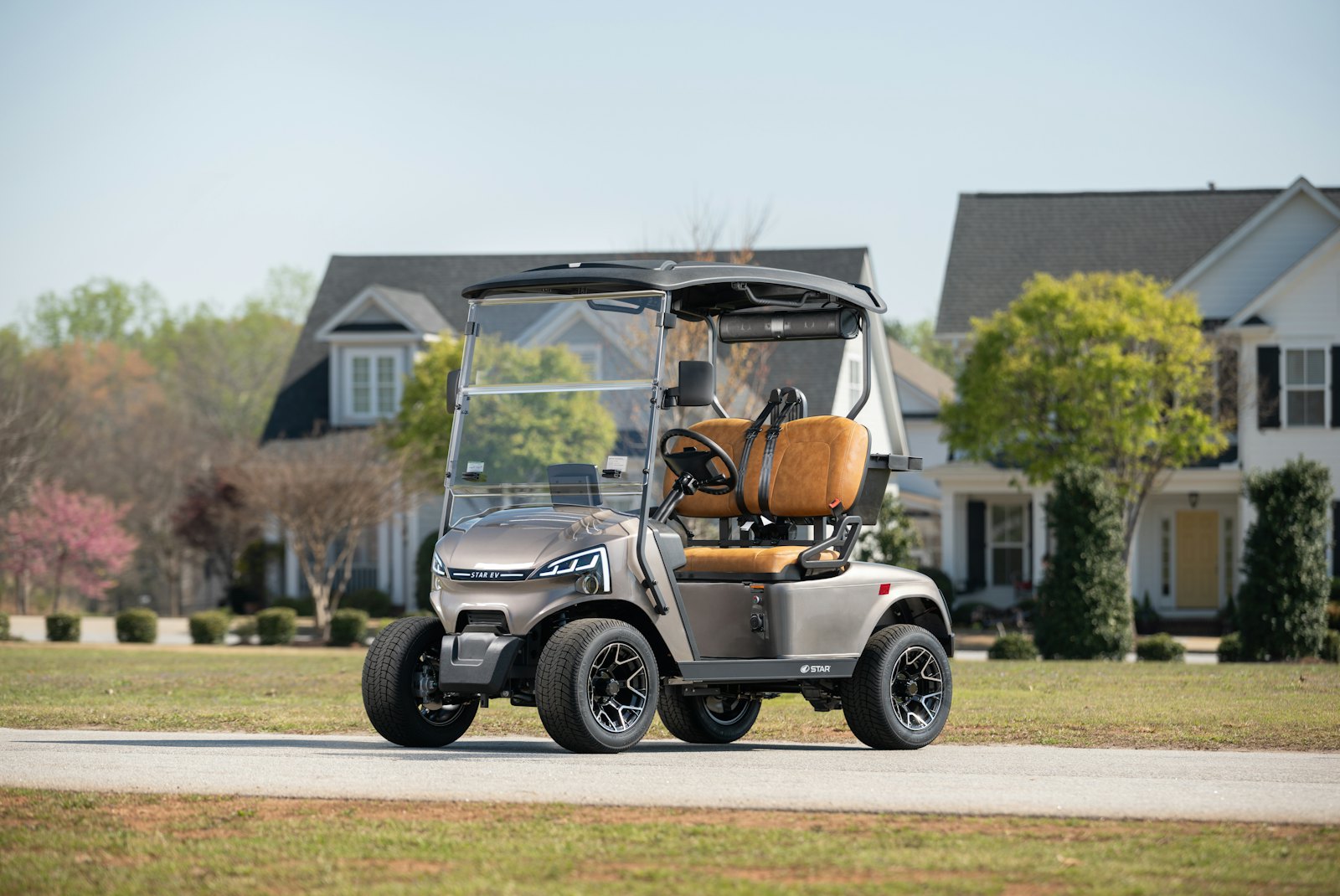
No. Golf cart rear seats are not truly universal. Some aftermarket kits are sold as “universal,” but safe fitment depends on the cart’s frame, model generation, rear body, roof supports, mounting points, suspension, and available tire clearance.
A rear seat should be treated as a structural passenger conversion, not just a cushion that can be bolted onto any cart.
Why rear seats are model-specific
The rear of an E-Z-GO TXT, E-Z-GO RXV, Club Car Precedent, Club Car DS, Yamaha Drive, Yamaha Drive2, and Evolution cart is built differently. The brackets that support the seat frame, footplate, grab bar, and rear roof supports are not interchangeable by default.
Even within one brand, production-year changes can affect mounting-hole location and body clearance.
What “universal” usually means
In many listings, “universal” means the kit can be adapted to several popular carts or uses adjustable brackets. It does not mean the kit has been engineered for every cart.
If a seller cannot identify the supported models and years, treat the fitment claim cautiously.
Five areas that must match
- Frame mounting: the main seat structure must attach to appropriate structural points.
- Roof supports: rear supports may be replaced or relocated by the kit.
- Body clearance: rear trim, bagwell, bumper, and fender shapes vary.
- Tire clearance: the footplate and seat frame must clear the tires through suspension travel.
- Suspension load: two rear passengers can add substantial weight over the rear axle.
Can TXT and RXV rear seats interchange?
Do not assume so. TXT and RXV are different E-Z-GO platforms with different frame and body architecture. A rear-seat kit listed only for TXT should not be installed on an RXV just because both are E-Z-GO carts.
What about Club Car DS and Precedent?
They are also different platforms. Club Car DS kits and Precedent/Tempo kits commonly use different mounting brackets and roof-support arrangements.
Some aftermarket manufacturers sell separate versions that look similar in photos, which is why checking the exact part number is important.
Yamaha Drive vs Drive2
Drive/G29 and Drive2 share some broad design heritage, but rear-seat fitment should still be confirmed by year and model. Roof supports, body panels, and accessory mounting geometry can differ.
Why rear-seat cushion width is not enough
A seller may advertise a cushion that appears to match the width of another cart. That does not prove the steel frame, hinge system, footplate, or grab bar is compatible.
The structural kit matters more than whether the cushion physically fits across the back.
What about flip seats?
Flip seats are popular because the rear cushion can convert into a cargo deck. Their hinge system and deck load are part of the frame design, so the correct model-specific bracketry matters even more.
Never assume a flip deck’s cargo rating equals its passenger rating.
Will a rear seat fit a lifted cart?
Often yes, but lift kits, oversized tires, spacers, and wheel offset can change rear clearance. Check whether the footplate, grab bar, or side brackets come close to the tire at full suspension movement.
A lifted cart can also be taller to enter, making a stable footplate and grab bar more important.
Do you need heavy-duty rear springs?
Not automatically, but extra passenger weight can make a stock rear suspension sag or bottom out. If the cart sits low, rubs tires, or becomes unstable with passengers, evaluate the rear springs, bushings, shocks, tires, and load rating.
Match the suspension to the real operating load rather than installing the stiffest spring available.
What should you verify before buying?
- Brand and model
- Model year or generation
- Gas vs electric if the kit specifies it
- Existing roof/support style
- Rear body configuration
- Lift and tire size
- Whether seat belts or grab bars are included
- Maximum passenger/cargo rating
- Installation instructions and required drilling
Can you adapt a kit from another model?
Custom fabrication is possible, but that is no longer a standard bolt-on installation. Passenger seating should not rely on improvised sheet-metal brackets or unsupported welds. If fabrication is required, use a qualified shop that understands structural loads and passenger restraint mounting.
Bottom line
Golf cart rear seats are not universally interchangeable. Choose a kit that explicitly lists your cart model and generation, then verify frame, roof-support, footplate, tire, and suspension fitment. A rear seat carries people, so “close enough” fitment is not a good standard.
